
Consumer
Does Loan Settlement Hurt Your CIBIL Score? How to Actually Remove the "Settled" Status
A
10 minKey Highlights
The envelope showed up on a Tuesday. Registered post, an advocate's letterhead, and inside, three pages accusing a small manufacturing unit in Pune of breach of contract — specifically, failing to deliver goods under a supply agreement signed eight months earlier. The owner read it twice, called his CA, then his cousin who "knows a lawyer," and by evening had convinced himself the case was basically lost.
It wasn't. A legal notice is a formal letter — usually from an advocate — laying out a grievance and demanding a specific remedy before the sender goes to court. Under Indian contract law, it is not a summons, not an FIR, and not proof of anything. It is a warning shot that also happens to be a courtesy: it tells you exactly what the other side plans to allege, and gives you time to respond before they file.
That time window is the answer you actually came here for: you have between 15 and 30 days to reply, and the exact number is set by the notice itself, not by a single statute that applies to every case. Most advocates draft a 15-day window as standard; some go to 30. Miss it, and you haven't lost automatically — but you've lost the easiest chance to shape the record before litigation starts.
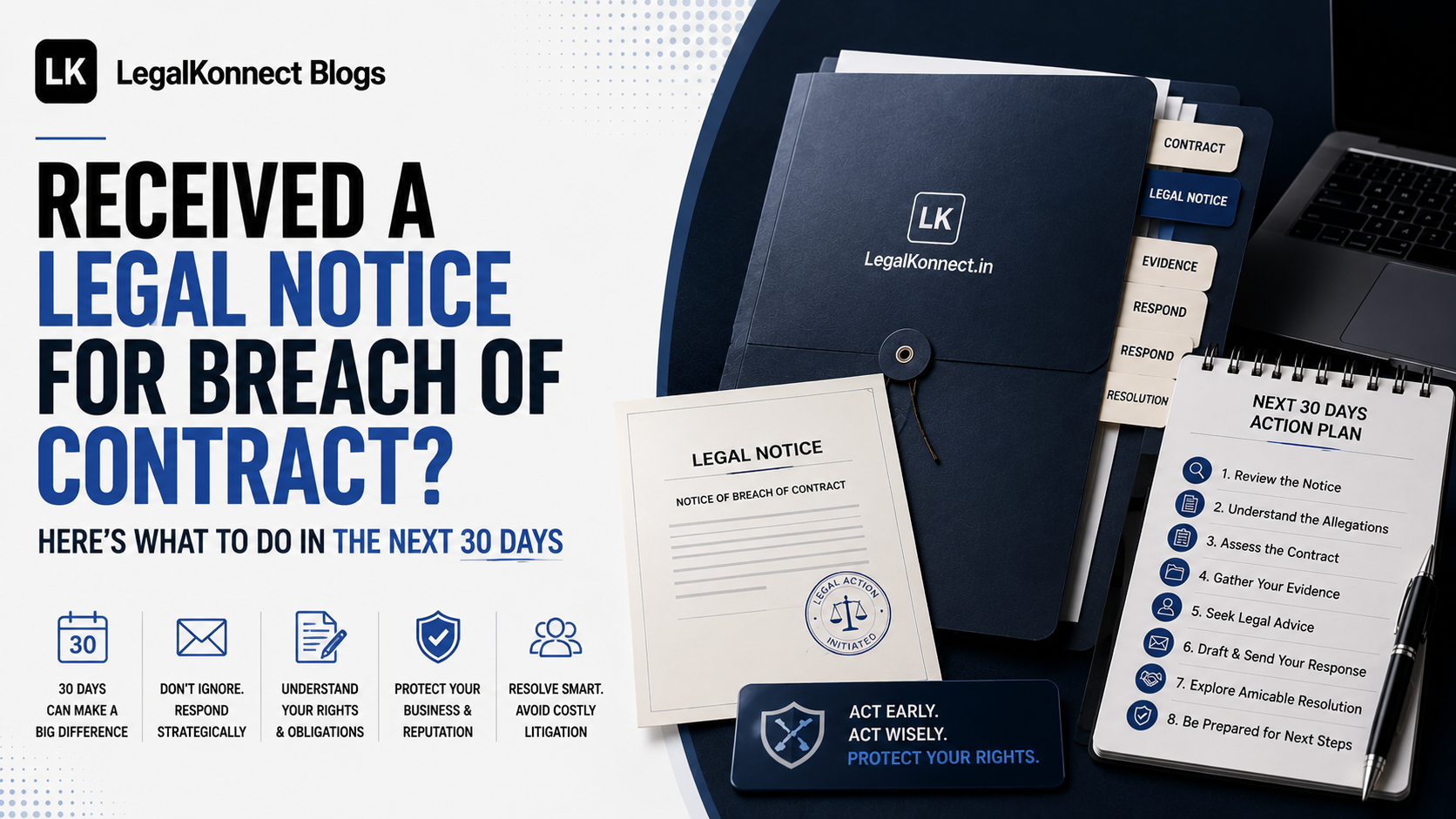
What you do inside that window matters more than any single legal argument. This is a day-by-day plan for the person who received the notice — what to do, in what order, and why each step protects you if this does end up in court.
Strip away the legalese and a breach-of-contract notice says three things: here's the agreement, here's what you allegedly failed to do, and here's what we want (money, performance, or both) by a certain date. It's typically sent under the general principles of the Indian Contract Act, 1872 — most commonly Sections 73 and 74, which govern compensation for breach.
There's no single central law that says "you must send a notice before suing for breach of contract" in every case. That surprises people, because notice requirements exist in specific contexts — arbitration clauses under Section 21 of the Arbitration and Conciliation Act, 1996 require a notice invoking arbitration before either side can approach a court or arbitrator, and suits against the government or a public officer require two months' notice under Section 80 of the Civil Procedure Code, a rule the Privy Council in Bhagchand Dagadusa v. Secretary of State for India (1927) called "express, explicit and mandatory," admitting "no implications or exceptions." Outside those situations, a pre-suit notice for a private commercial dispute is common practice — courts view a party that skipped straight to litigation less favourably, and if the dispute is a "commercial dispute" of specified value (currently ₹3 lakh and above) under the Commercial Courts Act, 2015, pre-institution mediation is mandatory before filing unless you're seeking urgent interim relief.
So: check who sent it. A notice from a private party or company is different from one referencing a government contract, a PSU, or an arbitration clause buried in your original agreement. That single fact changes which deadline actually governs your response.
Read the notice twice. The first time for the accusation, the second time for the deadline — it will usually say "within 15 days of receipt" or similar. Note the date you actually received it (the postal date on the envelope or courier slip, not the date on the letter), and count forward. That's your real deadline — count from the day it landed in your hands, not the date printed on the letter itself.
Do not call the other party. Do not send an angry WhatsApp message. Anything you say now, written or verbal, can be quoted back at you later. If you must acknowledge receipt, a one-line message confirming you've received the notice and are reviewing it is enough.
Before you decide how to respond, you need to know what you can actually prove. Gather:
The signed contract or purchase order, including any amendments
Invoices, delivery challans, or proof of performance on your side
All correspondence — email threads, WhatsApp messages, call logs if relevant — that shows what was actually agreed or changed after signing
Payment records: bank transfers, cheques, UPI confirmations
Any prior notices or reminders either side sent
This step matters because most contract disputes in India aren't decided on the written terms alone — they're decided on what the parties actually did afterward. If the delivery date in the contract was day 30 but both sides had been informally extending it by WhatsApp for months, that pattern is your evidence, and it needs to be in your folder before you draft a single sentence of your reply.
This is the decision that shapes everything after Day 30. You have three real paths, and the right one depends on specific facts in your contract, not gut instinct:
Dispute the breach if you genuinely didn't breach, or the breach isn't yours to answer for. Check: does the contract have a force majeure clause that covers what happened? Was there a prior written or even informal waiver — did the other party accept late delivery before without objection, which can undercut their claim that time was "of the essence"? Do the facts in the notice actually match what happened, or has the sender mischaracterised dates, amounts, or terms? If your documents from Day 4–7 support a real defence, this is your path — and your reply should lay out that defence clause by clause, not just deny the allegation in general terms.
Cure the breach if you did fall short but can still perform — deliver the goods, pay the outstanding amount, complete the pending work — within a realistic window. Courts and the other side both read a genuine cure attempt very differently from silence. The cure has to be real and documented: don't just say "we will deliver soon" — set an actual date, communicate it in writing, and then actually deliver. A cure offer you don't follow through on can end up looking worse than no offer at all, since an unmet promise, in writing, is easy for the other side to point to later as evidence you were stalling rather than genuinely trying to fix things.
Negotiate if the honest answer is somewhere in between — partial breach, mitigating circumstances, or a commercial relationship worth preserving. A without-prejudice settlement offer, made through your advocate, doesn't concede liability and can resolve the matter faster and cheaper than either full defence or full capitulation. This is worth taking seriously given how mediation actually performs once a matter reaches court: government data given to Parliament in January 2026 shows that pre-institution mediation under the Commercial Courts Act settled just 4,849 of 276,676 applications between July 2018 and September 2025 — roughly a 1.75% success rate. If mediation is likely to apply to your dispute later, a direct negotiated settlement now, before positions harden, has better odds than waiting for the mandatory process to do the work for you.
Whichever path you pick, put it in writing to your advocate before Day 15, because the actual drafting starts next.
Your reply is not a one-line "we deny everything." A reply that will actually hold up needs to be:
Para-wise — respond to each numbered paragraph of their notice individually, admitting what's true, denying what isn't, and clarifying what's misstated. A blanket denial reads as evasive and gives you nothing to point to later.
Factual, not emotional — no matter how unreasonable the other side's claim feels, the reply goes on record. Courts read tone. An advocate's letterhead with inflammatory language undermines your own credibility faster than it damages theirs.
Specific about your position — state clearly whether you're disputing liability, offering a cure with dates, or open to settlement, and back each with the document references from your Day 4–7 folder.
Careful about admissions — don't concede facts you haven't verified just to sound cooperative. If you're not sure a delivery date claim in their notice is accurate, say you're verifying it rather than agreeing to it.
Lawyer fees for drafting a reply to a legal notice typically run ₹5,000 to ₹25,000, depending on the complexity of the dispute and the seniority of the advocate — worth budgeting for even if you're confident you're in the right, because a poorly drafted reply can do more damage than no reply on certain specific facts, though generally some response is better than none.
Send the reply by a method that gives you a paper trail — registered post with acknowledgment due, or a reputed courier with tracking — and keep a copy with the dispatch proof. Email alone is weaker unless the contract or prior correspondence establishes email as an accepted mode of communication between the parties.
On the flip side, if you're the one who sent a notice earlier — say, invoking an arbitration clause under Section 21 of the Arbitration Act — and the other side stays silent, don't assume that silence hands you what you asked for. The Delhi High Court, in Supreme Infrastructure India Limited v. Freyssinet Menard India Private Limited (O.M.P.(COMM) 395/2024, decided 2025), held that a party's failure to reply to a Section 21 notice does not amount to consent to a unilaterally named arbitrator — the only proper route when the other side stays silent is to approach the court for an appointment. Silence cuts against the non-replying party in some respects and protects them in others; it isn't a blanket rule in either direction.
Everything above is written for the recipient, but a lot of senders end up here too, waiting out the 15-to-30-day window they wrote into their own notice. If the deadline passes and there's nothing back, three things follow — and it's worth being precise about which is which.
First, non-reply is evidence, not victory. A court can treat the other side's silence as a factor supporting your version of events, but it isn't a default judgment, and it doesn't shortcut you past having to prove your case if you sue — you still need the underlying contract, the proof of breach, and your damages calculation ready.
Second, silence doesn't hand you a mandatory process, either. If your dispute is a "commercial dispute" of ₹3 lakh or more, you still have to go through pre-institution mediation under the Commercial Courts Act before filing suit, non-reply or not, unless you're seeking urgent interim relief. Skipping that step because the other side ignored you is a procedural error that can get your suit thrown back at the filing stage.
Third — and this is the part senders tend to get wrong — a non-reply doesn't extend your own limitation period. The Limitation Act, 1963 still runs from the date of breach for most contract claims, not from the date you sent the notice or the date the reply deadline lapsed. If you've been waiting months on a notice hoping the other side blinks, check how much of your three-year window that waiting has already eaten. In practice, once the reply deadline has passed — or it's clear it won't be met — and mediation, if it applies, has run its course, that's the point to actually file. Not to keep sending follow-up notices while the clock quietly runs down.
Not replying doesn't automatically mean you lose. But courts, including the Delhi High Court, have on occasion treated non-reply to a legal notice as a factor supporting the truth of what the notice alleged — not conclusive proof, but a supporting inference a court can draw alongside other evidence. Silence reads as having nothing to say, and a court weighing your conduct against the documentary evidence can hold that against you.
Practically, it cuts two ways. If you have a genuine defence, staying silent wastes it. If you don't have one and you're hoping the other side won't follow through, you're betting on their inertia, not the law — and given that the Limitation Act, 1963 gives most contract claims three years from the date of breach, that's a long time to bet on someone staying lazy.
Sometimes the problem isn't your breach — it's their notice. Check for:
Wrong party — is the notice addressed to you personally when the contract was signed by your company, or vice versa?
No specified deadline or cure period — a notice that demands compliance without stating a reasonable time frame is on shakier ground if it ever needs to justify moving straight to litigation.
Vague allegations — "you have breached the agreement" without specifying which clause, which date, or which act, is a weak notice, and your reply should point that out explicitly and ask for particulars.
No notice at all where one was required — if your contract has an arbitration clause, or the dispute is with a government body, and the sender skipped the mandatory pre-suit step, that's a procedural defect worth flagging through your advocate, though it usually delays rather than defeats the claim.
A defective notice doesn't extend your Limitation Act clock or erase the underlying dispute — the claim, if genuine, will likely just be re-sent correctly. Treat a defective notice as a reason to be precise in your reply, not a reason to ignore it entirely.
Thirty days feels short when you're staring at an accusation with a lawyer's letterhead on it, but it's enough time to build a defensible position if you use it in order: read and diarise first, gather documents before you form an opinion, decide your path based on your contract's actual clauses rather than instinct, draft a reply that engages point by point, and send it with proof. What you don't want to do is spend three of those weeks deciding whether to take it seriously.
About the Author
Adv. Shivam Mehrotra
Verified advocate on LegalKonnect.
All articles are reviewed for legal accuracy before publication.
Meet the author