Debt Settlement
Your Loan Became an NPA: What Happens Next — and How to Settle It
A
10 minKey Highlights
You try to pay rent and the transfer bounces straight back. The balance is sitting right there in the app, but nothing will move out. The helpline reads out a line about a "lien marked on the instruction of the Cyber Crime Police Station, Bharatpur" — a town in Rajasthan you've never set foot in. No notice came. Nobody called. And ₹84,000 you need this week is frozen solid.
So here's the short version. If your bank account is frozen by a cyber cell, you can get it released — and the freeze is legally meant to cover only the disputed amount, not your whole balance. The two fastest routes: a written representation to the investigating officer for a no-objection certificate, and, if that stalls, a writ petition in the High Court.
Most people in this spot aren't the accused at all. They received money that, somewhere up the chain, turned out to be stolen. And it's common. In the first nine months of 2024, Indians lost ₹11,333 crore to cyber fraud, and the Indian Cyber Crime Coordination Centre (I4C) froze around 4.5 lakh "mule" accounts chasing that money. Plenty of them belong to someone who just sold an old phone on OLX, or a freelancer who got paid by a new client, and never knew the rupees coming in were dirty.
Bank staff use these two words like they mean the same thing. They don't, and the difference tells you how bad your situation is.
A lien earmarks a fixed sum — say ₹25,000 — and leaves the rest of your money usable. A debit freeze (some banks say "account on hold") blocks every outgoing rupee, whatever your balance. Money still comes in. Nothing goes out.
Ask the bank one thing in writing: is this a lien on a set amount or a full freeze, how much is blocked, and who instructed it. You'll need that answer, on record, for every step that follows. If it's a full freeze over a small disputed sum, you already hold the spine of your argument.
When a fraud victim complains on the cybercrime portal or the 1930 helpline, investigators follow the money. The stolen amount rarely sits still — it gets pushed through a chain of accounts to break the trail. A to B to C to yours. The portal flags every account the money touched, and banks freeze them on the police instruction, often before anyone has looked at who you actually are.
That's how a person who sold a second-hand iPhone for ₹18,000 gets frozen: the buyer paid with money stolen from someone else. You're now a link in a chain you never knew existed. Police call accounts like yours "mule" accounts — whether the holder was in on it or completely clueless.
One thing catches everyone off guard. The complaint usually sits wherever the victim lives, so your money froze on the say-so of a cyber cell in a different state. That makes it feel impossible to fight from where you are. It isn't.
A freeze is an investigative step, not a verdict. Being frozen does not mean you've been named an accused.
Short answer: they've long had the power to freeze accounts during an investigation — but how they're allowed to do it just changed, and that's working in your favour.
The old power sat in Section 102 of the Code of Criminal Procedure. Two Supreme Court rulings settled that a bank account is "property" that can be frozen during an investigation: State of Maharashtra v. Tapas D. Neogy (1999) 7 SCC 685, which also said there must be a genuine link between the account and the alleged offence, and Nevada Properties Pvt. Ltd. v. State of Maharashtra (2019), where a three-judge bench confirmed accounts stay covered even though land and flats can't be seized this way.
Here's what changed. For anything registered on or after 1 July 2024, the criminal code is now the Bharatiya Nagarik Suraksha Sanhita (BNSS), and it splits the power in two. Section 106 lets the police seize property to preserve evidence — and they must report it to the magistrate forthwith. Section 107 is the one that allows attaching property suspected to be proceeds of crime — and that needs an order from a Magistrate, not just a police instruction.
That distinction is now the whole ball game. Through 2025 and into 2026, the Kerala, Bombay and Delhi High Courts have each held that debit-freezing your bank account is an attachment, so it can't be done under Section 106 on a police email alone — it needs a Magistrate's order under Section 107. The Kerala High Court said it plainly in Headstar Global Pvt. Ltd. v. State of Kerala (2025). The Bombay High Court said the same in December 2025. The Delhi High Court followed in Malabar Gold and Diamond Ltd. v. Union of India (January 2026), holding that freezing the account of someone who is neither accused nor a suspect, with no Magistrate's order under Section 107, was illegal and violated Articles 19(1)(g) and 21.
So ask the question early: was there ever a Magistrate's order? If your account was frozen on nothing more than a forwarded police instruction, that freeze may itself be unlawful. One honest caveat — this is fresh High Court law, not a Supreme Court ruling yet, and some cells and banks still operate the old way. You may have to be the one who raises it.
Even where a freeze is properly ordered, it's meant to be proportionate — limited to the money actually under suspicion. That's your other strong card.
In Mohammed Saifullah v. Reserve Bank of India (Madras High Court, 2024), HDFC had frozen an account on a Telangana cyber cell's instruction, though only ₹2,48,835 was linked to the alleged crime. The court told the bank to de-freeze the account and keep a lien on just ₹2,50,000 — holding that locking an entire account without quantifying the disputed amount strips a person of the right to livelihood.
The Delhi High Court went the same way on starker facts. In Neelkanth Pharma Logistics (P) Ltd. v. Union of India (2025), a company's account — balance over ₹93 crore — was frozen over a credit of just ₹200 flagged by a Thane police station. Justice Manoj Jain pushed the Ministry of Home Affairs to frame a uniform policy so this stops happening blindly.
One honest caveat: the MHA still hasn't issued that single binding SOP, so practice splits by state. Some cells freeze only the disputed sum now. Others still lock everything and make you fight for the rest. The rulings hand you the argument. You usually have to make it.
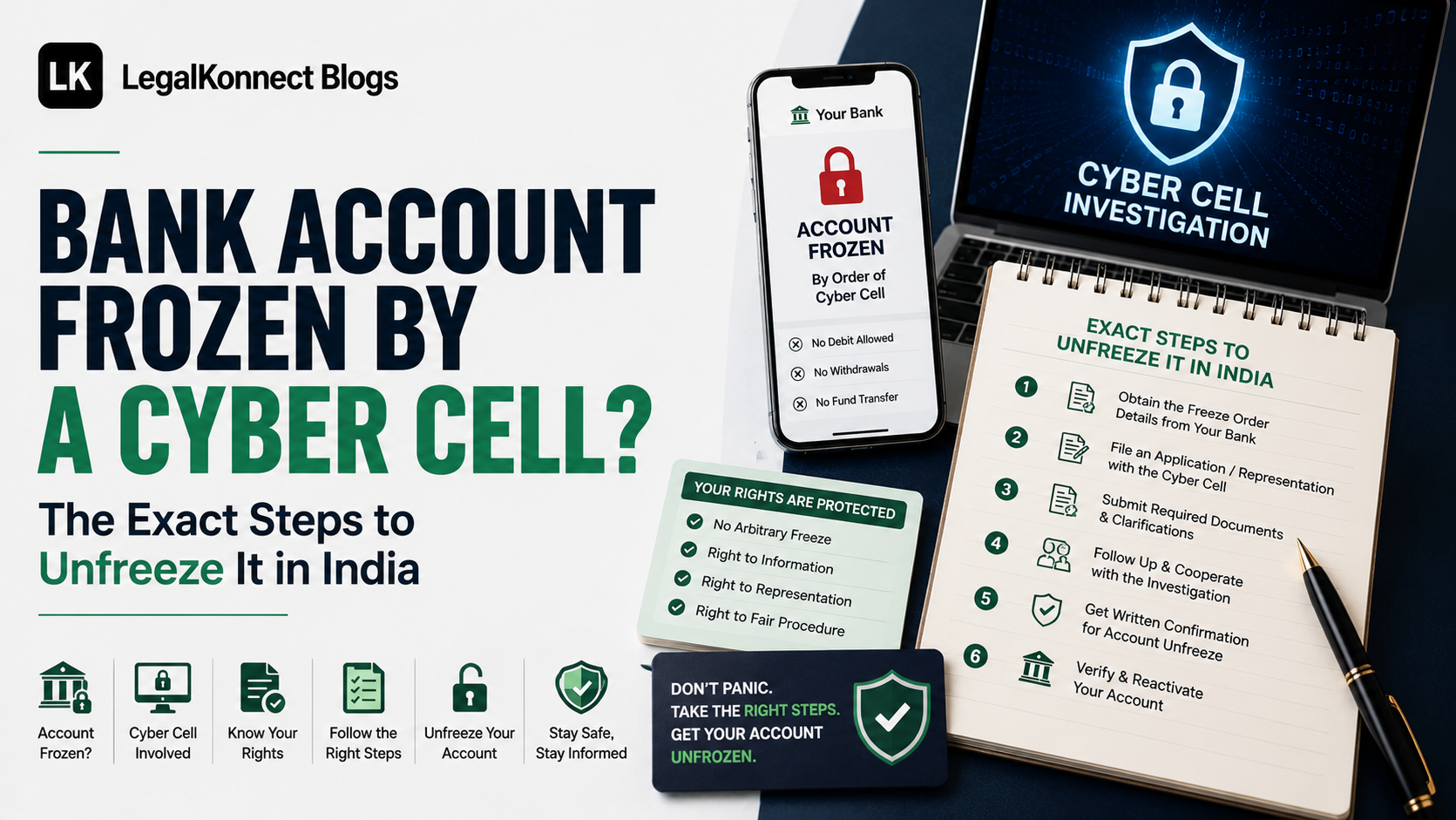
1. Get the facts in writing from your bank. Which cyber cell and which complaint or FIR triggered it, the freezing reference, the disputed amount, whether any Magistrate ordered it, and the police nodal officer's contact. Banks have a freeze desk for exactly this. Insist on it by email.
2. Send a written representation to the investigating officer — and copy the jurisdictional magistrate. Say plainly that you're a recipient, possibly a victim yourself, not the fraudster. Attach your ID, bank statements, and proof the transaction was genuine — the sale invoice, the buyer chat, the client's payment note. Ask the officer to verify your records and issue a no-objection certificate (NOC) to your bank. Send it by email and registered post, even if the cell sits in another state.
3. If the officer sits on it, go to the magistrate. File an application before the magistrate with jurisdiction over the case, asking for release of the frozen money (the property-release route long used under Sections 451 and 457 CrPC, now Sections 497 and 503 of the BNSS). The magistrate calls for the officer's report and can order release after hearing both sides.
4. If the freeze drags or you're stonewalled, file a writ petition under Article 226 in the High Court. This is often the quickest real lever. Two grounds carry weight right now: that the freeze was done under Section 106 with no Magistrate's order under Section 107, and that an open-ended freeze breaks your rights under Articles 19(1)(g) and 21. The petition usually names the police, the bank, and sometimes the state.
5. Press proportionality at every step. Writing to the officer or arguing in court, demand the freeze be capped at the disputed amount and the balance released. That's your strongest card. Use it early.
If the cell is in another state and the phone line goes dead, bring in an advocate who's actually run de-freezing applications — territorial jurisdiction for a writ can itself be contested, and the High Courts haven't always agreed on where you can file. Don't guess the court. You can book a consultation and get your own situation mapped before more time slips.
If you're plainly a victim and your papers are clean, the NOC route usually clears in one to three weeks. A magistrate's application runs roughly three to six weeks. A writ depends on the court's board, but interim relief — partial de-freezing — has come within a few weeks in several 2024–26 matters. A far-off, unresponsive cell is what turns a three-week problem into a three-month one.
On money: a representation plus a magistrate's application through an advocate runs somewhere between ₹5,000 and ₹25,000, depending on the city and who you brief. A writ costs more. You can send the representation yourself — that's allowed. But the moment it reaches a court, get an advocate.
Not every block is a cyber freeze. Sometimes the bank itself marks a lien for its own dues — an unpaid loan EMI, a credit-card outstanding, service charges. That comes from the banker's general lien under Section 171 of the Indian Contract Act, 1872. The fix is different: clear the genuine dues and get written confirmation the lien is gone, or, if the charge is wrong, dispute it with the branch, escalate to the bank's nodal officer, then to the RBI's Integrated Ombudsman. If the loan behind it has already slipped into default, what NPA status really means and how to settle it is a separate fight worth understanding before you negotiate. And if the pressure is arriving as calls and house visits rather than a freeze, remember that recovery agents have hard limits under RBI rules.
Occasionally it's neither — the income-tax department recovering dues by notice to your bank, or a civil court's garnishee order. So start with the one question you began with. Ask the bank, in writing, who told them to freeze it. Everything you do next runs off that answer.
Common questions about Debt Settlement
About the Author
Chandra Mauli Mishra
Verified advocate on LegalKonnect.
All articles are reviewed for legal accuracy before publication.
Meet the author