
Key Highlights
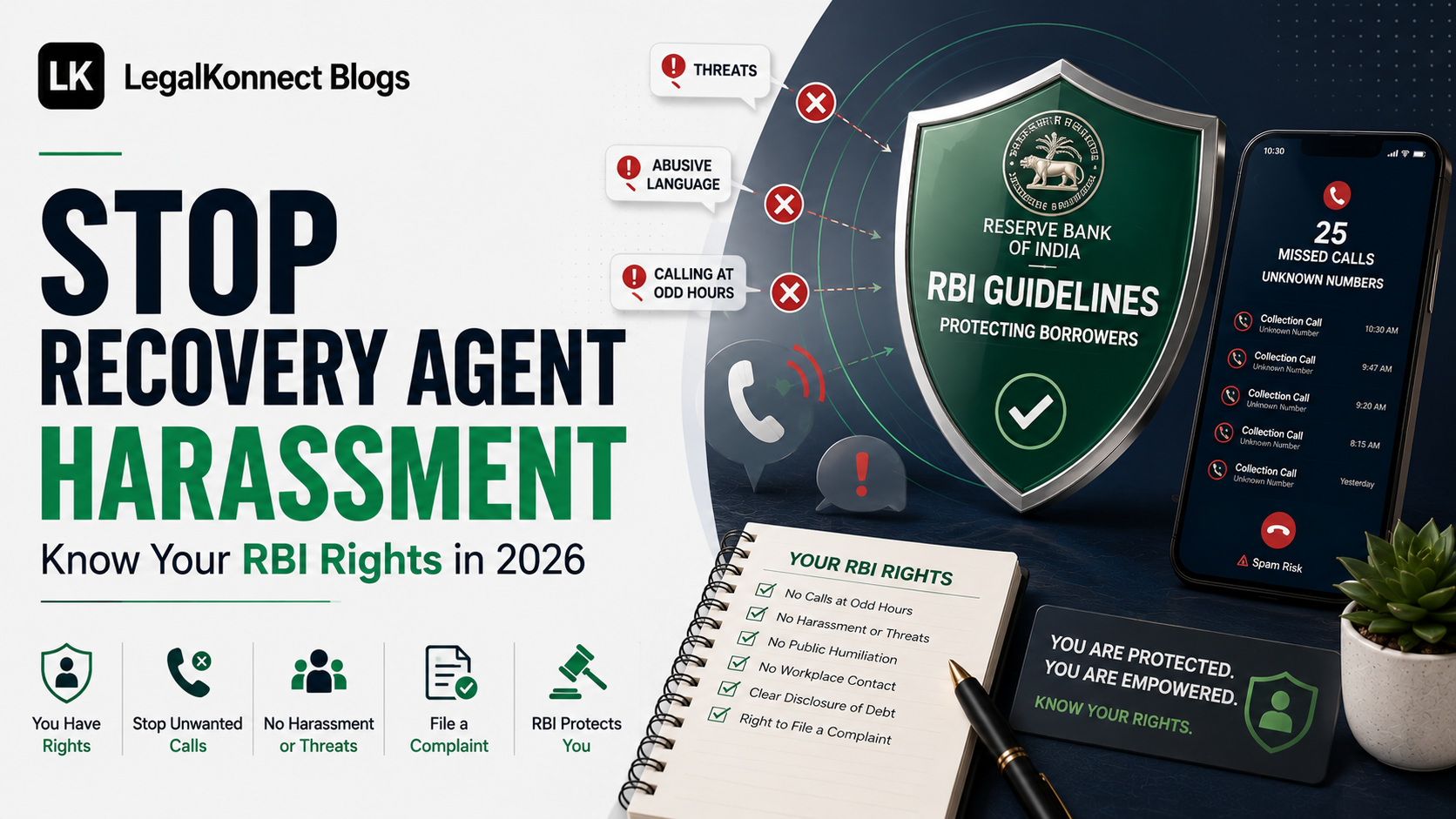
- A recovery agent can only contact you between 8 a.m. and 7 p.m. Calls outside that window, threats, abuse, or shaming you in public are banned — this has been binding since RBI's 12 August 2022 circular.
- The lender, not just the agent, is legally responsible for how the agent behaves. That is your single biggest point of leverage.
- You cannot be arrested for not repaying a loan. Default is a civil matter, not a crime — the only real exceptions are cheque bounce and fraud.
- The "2026 RBI rules" everyone is talking about are still a draft proposed for 1 July 2026. Your protection today rests on the 2022 circular, which already covers you.
- Complain to your lender's grievance officer first; if it's not resolved in 30 days, escalate free to the RBI Ombudsman at cms.rbi.org.in — which can order compensation.
- The Supreme Court has repeatedly held banks cannot use musclemen or force to recover money or seize assets.
- Stopping the harassment does not clear the debt. Settling it properly is the actual fix.
The calls start before you're awake and continue well after dinner. The agent has spoken to your spouse, perhaps your employer. There may have been a visit to your home or your workplace, and the word "jail" said where others could hear it. You are behind on an EMI — and you are left wondering how much of this a recovery agent is actually permitted to do.
Take Ramesh, who runs a small printing shop in Lucknow. A slow season left him two EMIs behind on a ₹4,00,000 personal loan, and within weeks a recovery agent was calling before 8 a.m. and well past 9 p.m., had contacted his wife and his landlord, and was turning up at the shop. Like most borrowers, he assumed he simply had to put up with it.
He didn't. Recovery agent harassment is, in almost every form, against the law. RBI's rules bind every bank, NBFC, and their recovery agents: an agent may contact you only between 8 a.m. and 7 p.m., and may not threaten, abuse, or publicly shame you, or pull your family into it. And you cannot be arrested for failing to repay a loan.
That is the short version. What follows is what the rules actually say, what is genuinely new for 2026, and the precise steps to make the harassment stop.
What the RBI Rules Say About Recovery Agent Harassment
The core protection isn't vague "fair practice" language — it's a specific, dated instruction. RBI's circular of 12 August 2022 (Outsourcing of Financial Services – Responsibilities of regulated entities employing Recovery Agents) lays down hard limits. A recovery agent must not:
Call you before 8:00 a.m. or after 7:00 p.m.
Call persistently to hound you.
Use intimidation or harassment — verbal or physical — against you, your family, or anyone else.
Publicly humiliate you or intrude on your privacy.
Make threatening or anonymous calls or false representations about what they can do to you.
This applies across the board — commercial banks, co-operative banks, NBFCs, housing finance companies, and asset reconstruction companies. And here's the part that's quietly powerful: the rules make the lender itself responsible for what its recovery agent does. The agent is acting on the bank's behalf, so the bank wears the consequences of his behaviour.
So what does this mean for you? Every late-night call, every threat, every call to Ramesh's wife is not just "rude" — it's a breach the bank is on the hook for. That flips the power. You're not a defaulter begging for mercy; you're a customer documenting a regulated entity's misconduct.
The "2026 RBI Rules" — What's New, and What's Still Just a Draft
You've probably seen headlines about tough new "2026 RBI rules" for recovery agents — and a lot of sites quoting them as if they're already binding. They aren't yet. Here's the real status.
On 12 February 2026, the RBI released draft amendment directions on the conduct of lenders and recovery agents — proposed to slot into the RBI Responsible Business Conduct Directions, 2025 — and invited public comments (the consultation window closed on 6 March 2026). They are proposed to take effect on 1 July 2026, and would apply across every kind of lender, from banks to NBFCs. If finalised as drafted, they tighten things further: every recovery agent may need to be certified by the Indian Institute of Banking and Finance (IIBF) before contacting any borrower, and contacting your relatives, friends, or co-workers would be spelt out as off-limits.
But a draft is not law. It's a proposal that can still change before it's notified — so if an agent tells you "the new 2026 rules don't apply yet, so I can do what I like," that's a misdirection. Your protection right now doesn't rest on the 2026 draft at all. It rests on the 2022 circular, which is already in force and already bans almost everything an abusive agent does.
So what does this mean for you? Don't wait for July 2026 to push back. The rules that stop harassment are live today. The 2026 changes, if and when they're notified, mostly make explicit what the existing rules already require.
Can a Recovery Agent Come to Your House or Call Your Family?
This is the question that comes up most, because it's where agents push hardest. The honest answer has nuance.
Coming to your house: An agent is not outright barred from visiting, but the visit must stay within the rules — only between 8 a.m. and 7 p.m., no force, no intimidation, no creating a scene to shame you in front of neighbours. An agent who bangs on your door at night, refuses to leave, or threatens you has crossed from "visit" into harassment.
Calling your family or workplace: Calling your spouse, parents, or boss to pressure or embarrass you into paying is harassment, full stop. Your debt is between you and the lender. Roping in others to humiliate you is exactly the conduct the RBI rules prohibit — and the 2026 draft proposes to ban it even more explicitly.
Taking your car or entering your home by force: For a secured loan (car, home), the lender does have rights over the asset — but it cannot simply seize it by muscle. The Hon'ble Supreme Court in Citicorp Maruti Finance Ltd v. S. Vijayalaxmi (2012) held that a financier cannot forcibly repossess a vehicle; it must follow due legal process. Years earlier, in ICICI Bank Ltd v. Prakash Kaur (2007), the Court deprecated the use of "musclemen" for recovery and made clear recovery has to go through lawful channels.
So what does this mean for you? An agent at your door isn't automatically illegal — but the moment there's a threat, a scene, a forced entry, or a grab at your vehicle, the law is firmly on your side.
First, Kill the Fear: Can You Be Arrested for Not Paying?
Agents lean on one word more than any other: jail. So clear this up before anything else.
Failing to repay a loan is a civil matter, not a crime. No police officer can arrest you, and no court can jail you, simply because you couldn't pay an EMI. The lender's remedy is to recover the money through civil means — a recovery suit, the Debt Recovery Tribunal for larger loans, or SARFAESI action for secured loans. None of that is a criminal arrest.
There are narrow exceptions, and it's worth being straight about them: if you paid by cheque and it bounced, that's a separate criminal offence under the Negotiable Instruments Act; and if there was genuine fraud — fake documents, taking a loan with no intention to repay — that can attract criminal liability. But ordinary inability to pay? That is not jailable.
A note on the agent's own conduct: when an agent threatens, abuses, or trespasses, he may be the one crossing into criminal territory — offences like criminal intimidation and trespass now sit under the Bharatiya Nyaya Sanhita (BNS), 2023, which replaced the old Penal Code from 1 July 2024. The person who should be worried about the police is often the one making the threats.
So what does this mean for you? The scariest thing the agent says is the least true. Once the jail threat loses its grip, you can deal with this calmly and on your terms.
How to Make the Harassment Stop — Step by Step
Knowing your rights only helps if you use them. Here's the ladder, in order.
1. Document everything. Save call logs with dates and times (those after-7-p.m. calls are gold). Keep recordings, screenshots of threatening messages, and the names of anyone who witnessed a visit. This is the evidence that turns "he harassed me" into a complaint a regulator acts on.
2. Send a written complaint to the lender's Grievance Redressal Officer. Every bank and NBFC has one. State the dates, times, and exactly what the agent did, and that it breaches RBI's recovery-agent rules. Send it by email and keep proof. The lender is responsible for its agent — make it own the problem in writing.
3. Escalate to the RBI Ombudsman if the lender doesn't fix it. If you get no response in 30 days, or a response you're not satisfied with, file a complaint — free — with the RBI Ombudsman at cms.rbi.org.in. The Ombudsman can direct the lender to stop the conduct and can award compensation for the harassment and the distress caused.
4. Go to the police / cyber cell for threats or violence. If an agent threatens you, trespasses, or turns up with goons, that's a police matter — file a complaint at the station or the cyber portal for abusive calls/messages.
So what does this mean for you? You hold three escalating levers — the lender's own grievance channel, the RBI Ombudsman, and the police — and using even the first one in writing usually changes the agent's tone overnight, because now the bank's compliance team is watching.
Harassment Stopped — Now Deal With the Actual Debt
Here's the part the panic hides: stopping the harassment doesn't make the loan disappear. The calls were the symptom. The debt is the disease.
Once the pressure is off, you have room to deal with the real problem honestly. If you genuinely can't pay in full, you can often negotiate a one-time settlement with the lender — paying an agreed reduced amount to close the loan. It's not free of consequences (a "settled" status does hurt your credit score for years), but it's a structured, lawful exit that ends the matter — far better than years of dodging calls.
So do two things, in order: stop the harassment with the steps above, then deal with the debt itself. For Ramesh, a written complaint ended the late-night calls within days — and an advocate then negotiated a settlement on the ₹4 lakh he couldn't pay in full, with a No-Dues Certificate at the end. If the debt is the real weight, book a consultation with a verified advocate who deals with the lender for you.
Frequently Asked Questions
Common questions about Debt Settlement
About the Author
Adv. Urvashi Goswami
Verified advocate on LegalKonnect.
All articles are reviewed for legal accuracy before publication.
Meet the author