
Key Highlights
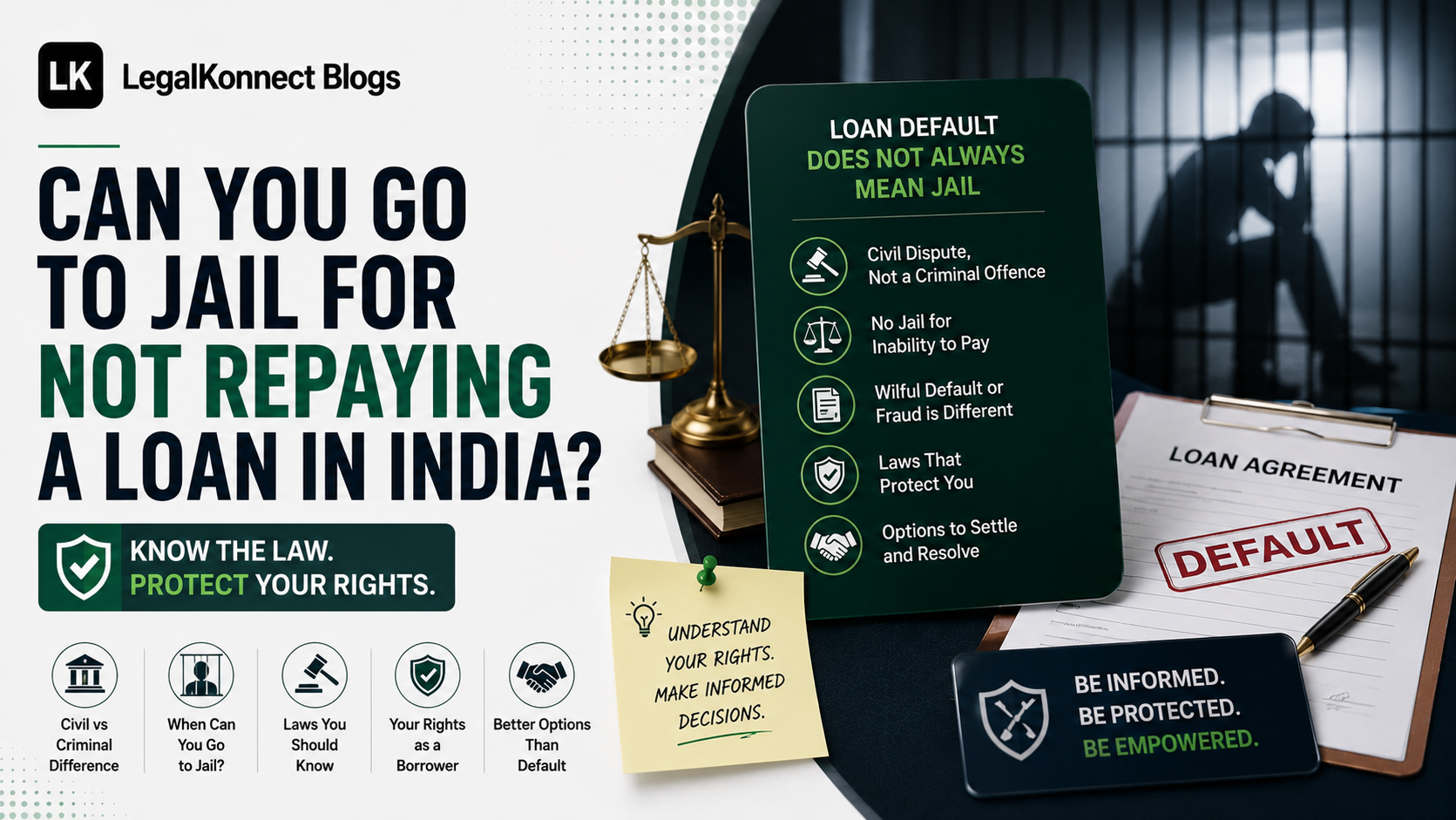
- Not repaying a loan is a civil breach of contract, not a crime. You cannot be arrested or jailed merely because you don't have the money.
- There is one narrow route to jail in a purely civil case: after the lender wins a decree, a court can order detention up to 3 months — but only if it finds you have the means to pay and are refusing, or you've dishonestly hidden assets.
- The Supreme Court settled this in Jolly George Verghese v. Bank of Cochin (1980): poverty is not a crime, and inability to pay is not contempt of court.
- The biggest real jail risk is a bounced cheque or NACH mandate — Section 138 of the Negotiable Instruments Act carries up to 2 years' imprisonment, and over 35 lakh such cases were pending in Indian courts as of end-2019.
- A Section 138 case is bailable and can be settled at any stage — even after conviction — though settling late usually costs more. Ignore the summons repeatedly, though, and a magistrate can issue a non-bailable warrant.
- Loan default becomes the crime of cheating (Section 318, Bharatiya Nyaya Sanhita) only if you took the loan with fraudulent intent from the start — fake documents, forged income proof, never intending to repay.
- For a plain civil default, recovery agents threatening arrest are bluffing — but a Section 138 summons you ignore is a different matter. The harassment itself is reportable — to the police and to the RBI's complaint portal.
The call comes at 8:45 on a Tuesday night. A man who says he's from the bank's "legal department" tells Rohan, a shop owner in Ghaziabad, that a warrant is being prepared, that police will come to his house in front of his neighbours, that he'll be behind bars by the weekend — all because he's four EMIs behind on a ₹3 lakh personal loan.
Rohan doesn't sleep that night. Almost everything the caller said is legally false.
So, can you go to jail for not repaying a loan in India? For simply not having the money — no. Loan default is a breach of contract under the Indian Contract Act, 1872, which makes it a civil dispute. The lender can sue you, seize secured assets, and wreck your credit score, but no police officer can arrest you and no magistrate can jail you merely because you're broke. That's the answer for the overwhelming majority of defaulters, and it's worth saying plainly.
But an honest answer has to cover the exceptions, because jail is genuinely possible in three specific situations: when a cheque or auto-debit mandate you gave the lender bounces, when the loan itself was obtained by fraud, and when a civil court has already passed a decree against you and finds you have money but are refusing to pay. The law doesn't punish poverty. It punishes dishonesty. The rest of this article walks through exactly where that line sits, stage by stage.
The rule: no prison for being unable to pay
Start with the foundation. When you signed the loan agreement, you made a contract. Breaking a contract — even badly, even for years — is not a crime in India. The lender's remedies are civil: a recovery suit, a case before the Debts Recovery Tribunal (DRT, for bank claims of ₹20 lakh and above), or action under the SARFAESI Act if the loan is secured against property.
None of that urgency on the lender's side is arbitrary. Once your account slips into NPA, RBI provisioning norms require the bank to set aside capital against the expected loss, and the RBI's own recovery-timeline directions push regulated lenders toward notices, suits, DRT filings, or SARFAESI action on a fairly tight clock rather than letting accounts drift indefinitely. That regulatory pressure on the lender is real and legitimate — it just doesn't licence threats of arrest, which is a separate line the recovery agent has no right to cross.
India also carries an international commitment here. Article 11 of the International Covenant on Civil and Political Rights, which India has ratified, says no one shall be imprisoned merely on the ground of inability to fulfil a contractual obligation. The Hon'ble Supreme Court read that principle into Indian law in the case that governs this entire question.
Jolly George Verghese v. Bank of Cochin (1980). A Kerala court had ordered the arrest of judgment-debtors under Section 51 of the Civil Procedure Code to recover a bank's decree. Justice Krishna Iyer, writing for the Supreme Court, set the order aside and laid down the test that still applies: a person cannot be sent to civil prison simply because they owe money and haven't paid. The court must find something more — that the debtor has or has had the means to pay since the decree and is refusing or neglecting to do so in bad faith, or has dishonestly transferred or concealed property. In the court's framing, "to be poor... is no crime."
What this means for you: if your income collapsed, your business failed, or a medical emergency ate your savings, and that's actually why you can't pay — the law treats you as an honest debtor in difficulty, not a criminal. Every threat of jail you receive should be measured against that test.
The one real route to jail in a civil case — and its limits
"Civil means no jail, ever" is not quite the full truth.
After a lender sues you and wins, the court issues a decree — a formal order that you owe the money. If you still don't pay, the lender files for execution, and one of the tools available is Section 51 read with Order 21 Rule 37 of the Civil Procedure Code: arrest and detention in civil prison.
But the safeguards are heavy, and they exist precisely because of Jolly George Verghese:
You get a hearing first. Order 21 Rule 37 requires the court to issue a show-cause notice — you appear and explain why you shouldn't be detained — rather than a straight arrest warrant in the ordinary course.
The court must record reasons in writing and be satisfied you're either likely to abscond, have dishonestly transferred or concealed property, or have the means to pay and are refusing. Mere non-payment is not enough.
Detention is capped. Under Section 58 CPC, the maximum is 3 months where the decree exceeds ₹5,000, and only 6 weeks for decrees between ₹2,000 and ₹5,000. Below ₹2,000, detention isn't allowed at all. These rupee thresholds are decades old and were never revised for inflation, so in practice they've collapsed into a single tier — virtually every real loan decree today, personal or business, clears ₹5,000 several times over, which means the 3-month cap is the one that actually applies. The 6-week band is a historical curiosity, not a live scenario for most borrowers.
It's civil prison, not a criminal sentence. You get no criminal record, and you're released the moment the amount is paid or the decree-holder stops paying your subsistence allowance.
Detention doesn't erase the debt. The liability survives — which is exactly why courts treat it as a pressure tool against wilful evaders, not a punishment for the poor.
So the honest map looks like this: yes, jail exists at the very end of the civil road, but only for the debtor who has money and hides it. A salaried person who lost their job and has no assets to conceal essentially cannot be sent to civil prison, no matter how loudly a recovery agent claims otherwise.
The cheque bounce fork: where most real jail risk lives
Now for the exception that fills actual courtrooms. If you handed the lender post-dated cheques as security, or signed a NACH/ECS auto-debit mandate, and that instrument bounces for insufficient funds, you've stepped out of pure contract law and into Section 138 of the Negotiable Instruments Act, 1881 — a quasi-criminal offence punishable with imprisonment up to 2 years, or a fine up to twice the cheque amount, or both. Dishonoured electronic debits are treated similarly under Section 25 of the Payment and Settlement Systems Act, 2007.
This is not a theoretical risk. In its suo motu case In Re: Expeditious Trial of Cases under Section 138 of NI Act (2021), the Supreme Court recorded that as of 31 December 2019, about 35.16 lakh cheque bounce cases were pending — out of roughly 2.31 crore total criminal cases in the country — a backlog that has only grown since. The court called it an "intractable problem." When a lender threatens a 138 case, that threat is real in a way the "police will arrest you tonight" theatre is not.
A Section 138 case has more exits than its reputation suggests:
It starts slow. After the cheque bounces, the lender must send you a demand notice within 30 days of receiving the bank's return memo. You then get 15 days to pay. If you pay within those 15 days, no offence is made out at all. Only after that can a complaint be filed before a magistrate.
It's bailable — but only if you show up. If summoned, you appear, furnish bail, and contest or settle. There is no dramatic arrest at your doorstep for a first summons. But that protection depends on responding: skip hearings repeatedly and the magistrate can issue a non-bailable warrant, which is the one way a 138 case does turn into the doorstep scenario people fear. The safe move is to always appear or have counsel appear for you, never to ignore the notice.
You can settle at any stage — even after conviction. Section 147 of the NI Act makes the offence compoundable. In Damodar S. Prabhu v. Sayed Babalal H. (2010), the Supreme Court laid down a graded-cost scheme to push parties to settle early: no costs if you compound at the first or second hearing, and rising costs — up to 20% of the cheque amount — the later you leave it. Note that a 2025 Supreme Court ruling (Rajeev Khandelwal v. State of Maharashtra) has since clarified that this cost scheme is a guideline, not a binding mandate — courts retain discretion to waive costs, for instance where the accused genuinely cannot pay. Even so, the practical lesson holds: settling early remains the safer, cheaper default, not something to gamble against.
Interim compensation is possible but not automatic. Under Section 143A, the court may direct you to pay up to 20% of the cheque amount while the trial is pending. In Rakesh Ranjan Shrivastava v. State of Jharkhand (2024), the Supreme Court clarified this power is discretionary, not mandatory — the court must weigh the prima facie merits and can consider the accused's financial distress.
And a practical reality check: even on conviction, magistrates in genuine inability-to-pay loan cases frequently impose a fine or compensation rather than a prison term, especially for first-time offenders — though this is the judge's discretion, not a rule you can bank on.
When default becomes cheating: the fraud line
The third route to jail is fraud. If you obtained the loan by deception — forged salary slips, fake ITRs, a fabricated identity, inflated collateral documents — the lender can pursue you for cheating under Section 318 of the Bharatiya Nyaya Sanhita, 2023 (the provision that replaced the famous Section 420 IPC when the BNS came into force on 1 July 2024). Cheating that dishonestly induces delivery of property carries imprisonment up to 7 years. Where you were entrusted with money or property and misappropriated it, criminal breach of trust under Section 316 BNS can also come into play.
The word doing all the work here is intent — and it must exist at the moment you took the loan. Courts look for deception at inception: did you lie to get the money, or never intend to repay from day one? A borrower who took a loan honestly, paid EMIs for a year, and then hit a financial crisis has no fraudulent intent to prove — subsequent inability is not cheating. This distinction matters because lenders sometimes file cheating complaints as pressure tactics on plain defaults, and courts have repeatedly quashed criminal cases that are really civil disputes dressed up in criminal clothing. If that happens to you, an advocate can move the High Court to quash the FIR — but take the complaint seriously and respond through counsel, never ignore it.
When you can actually go to jail for not repaying a loan: stage by stage
Here is the road, stage by stage, with the honest jail risk at each point:
EMI missed (day 1–30). The account is tagged SMA-0, then SMA-1 (30–60 days overdue), then SMA-2 (60–90). You'll get calls and penal charges. Jail exposure: zero.
90 days overdue. The account becomes a Non-Performing Asset (NPA). The default is reported to CIBIL and other credit bureaus, where it can haunt your credit history for years. Jail exposure: zero.
Legal notice. The lender's advocate sends a demand notice. This is a letter, not a court order. Jail risk: none at this stage — but this is the golden window to negotiate.
Recovery proceedings. A civil suit, or a DRT application (bank claims of ₹20 lakh+), or — for secured loans — a 60-day notice under Section 13(2) of the SARFAESI Act, after which the bank can take possession of the mortgaged asset without going to court (Mardia Chemicals v. Union of India, 2004, upheld this power while preserving the borrower's right to reply and to appeal to the DRT). You can lose the asset here, but not your liberty. Note also that a money suit generally must be filed within 3 years of default under the Limitation Act.
Wilful defaulter tagging. For outstandings of ₹25 lakh and above, the RBI's Master Directions on Treatment of Wilful Defaulters (2024) require lenders to examine whether you had the capacity to pay but didn't, diverted the funds, or disposed of secured assets. The tag cuts off future institutional credit — severe, but by itself it is a financial blacklist, not a criminal conviction.
Decree and execution. Only now does the Section 51 CPC possibility open — and only against the debtor who fails the Jolly George Verghese test. Jail exposure: conditional, capped at 3 months civil prison.
Parallel forks at any point: a bounced security cheque triggers Section 138 (real but bailable and settleable, provided you respond to the summons), and provable fraud at inception triggers Section 318 BNS — the one route with real criminal teeth.
For an honest borrower, the journey from missed EMI to decree involves no jail exposure at all. Every scary call you receive before a court has even passed a decree is negotiation pressure, not law.
When the recovery agent threatens arrest
The Supreme Court has been blunt about coercive recovery. In ICICI Bank v. Prakash Kaur (2007), the Hon'ble court deprecated banks' use of "musclemen" recovery agents and held that lenders must recover dues through procedures recognised by law, not strong-arm tactics. In ICICI Bank v. Shanti Devi Sharma (2008) — a case arising from a suicide following alleged agent humiliation over a repossessed motorcycle — the Supreme Court again refused to let the bank walk away from the episode, ordering the police investigation to proceed and the bank to pay costs, reiterating that recovery must respect the borrower's dignity.
The RBI's conduct rules back this up: under the Fair Practices Code that regulated lenders must follow, and the recovery agent guidelines built on it, agents may contact you only between 7 AM and 7 PM, must identify themselves, and cannot threaten, abuse, humiliate you publicly, or harass your family and contacts. (For app-based loans, the RBI (Digital Lending) Directions, 2025 add a further layer of borrower protections on top of this — they don't replace the 7 AM–7 PM window, they sit alongside it.) Go back to the opening scene: the call Rohan received at 8:45 PM was already a violation of the contact window before the caller uttered a single false word about warrants. An agent claiming "police are coming" for a civil default is describing something that cannot happen at this stage of a purely civil default.
Your counter-playbook, concretely:
Preserve evidence. Record calls where lawful, save messages and screenshots, note dates, times, numbers, and the agent's name and agency.
Complain to the lender first through its grievance redressal officer (every regulated lender must have one) and get a complaint number.
Escalate to the RBI. If unresolved in 30 days (or the reply doesn't satisfy you), file online under the RB-IOS integrated ombudsman scheme at cms.rbi.org.in — it's free and takes about fifteen minutes.
Go to the police if threatened. Criminal intimidation, abuse, and trespass by agents are offences under the BNS. File a complaint at your local police station; harassment doesn't become legal because the harasser works for a bank.
A special word on loan apps: if the "lender" is an app threatening to call everyone in your contact list or send fake "court notices" on WhatsApp, check whether it's even linked to an RBI-regulated entity — the RBI (Digital Lending) Directions, 2025 (which superseded the 2022 guidelines) require digital loans to flow from regulated lenders with named recovery agents and a grievance officer. Unregulated apps have little or no lawful recovery route — in many states an unlicensed lender's loan contract is itself unenforceable under the local money-lending law. Their jail threats are pure theatre, and contact-list shaming is itself ground for a police complaint and a report on the RBI's Sachet portal.
If you genuinely can't pay: do this, in this order
The worst strategy is silence — every protection above works better for a borrower who engaged early and honestly.
Contact the lender before they contact you. Ask in writing for restructuring: a lower EMI over a longer tenure, or a moratorium of a few months. Banks routinely prefer this to litigation.
Consider a one-time settlement (OTS) if the situation is truly beyond repair — the lender accepts a lump sum lower than the outstanding and closes the account. Know the cost: it's reported to CIBIL as "settled," not "closed," which hurts your score for years. Get every OTS term in writing before paying a rupee.
Use Lok Adalats. Banks bring bulk recovery cases to national Lok Adalats, where settlements are routinely struck at meaningful discounts and the award has the force of a decree — finality for both sides, no appeal, no further harassment.
Get an advocate involved early if you receive a Section 138 notice (those 15 days matter enormously, and missing later hearings is what turns a bailable case into a warrant), a SARFAESI notice (you have a right to object under Section 13(3A) and appeal to the DRT), or any criminal complaint. Timelines in these proceedings are short and unforgiving.
The law's design is consistent: every tool to recover money from those who have it, and no jail for those who don't. Fear of prison shouldn't drive your decisions — but a bounced security cheque you don't answer, a forged document, or hidden assets change the game entirely. Know which side of the line you're on, and act early.
About the Author
Adv. Urvashi Goswami
Verified advocate on LegalKonnect.
All articles are reviewed for legal accuracy before publication.
Meet the author